
Watercolor painting of Des Moines, Iowa at dusk seen from above, with the Iowa State Capitol dome at the left and the downtown towers beyond
MadeTimeCo

Old problems. New solutions.

I partner with businesses to find where we can use AI to save time, save money, reduce errors, and put better work in front of their customers.

Gibson Rivas, founder of MadeTime Co
Gibson Rivas Founder, MadeTime Co
Mechanical Engineering, Iowa State University
Minor in Sales Engineering
Who am I?

Hi, I'm Gibson.

I work with small and medium businesses that don't have the resources to hire an entire AI implementation team. I find where these tools solve a genuinely painful problem, build that into your work, and train your team on safe, proper use so everyone's comfortable with it.

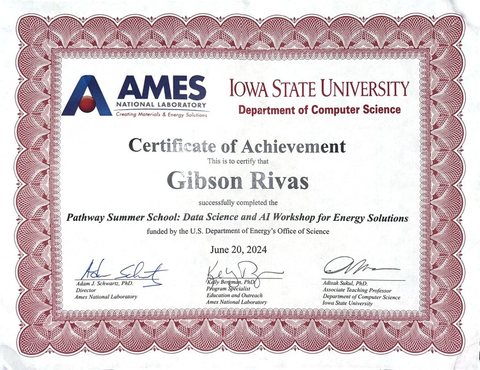
Certificate of Achievement awarded to Gibson Rivas, Pathway Summer School: Data Science and AI Workshop for Energy Solutions
Data Science and AI Certificate. Ames National Laboratory and Iowa State University, 2024.
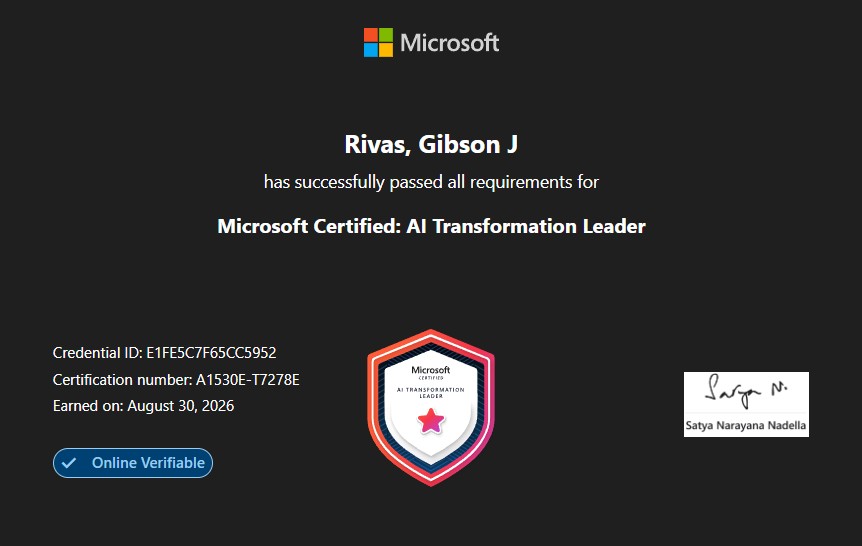
Microsoft certificate: Rivas, Gibson J has successfully passed all requirements for Microsoft Certified: AI Transformation Leader, earned August 30, 2026
Microsoft Certified: AI Transformation Leader. Exam AB-731, 2026.
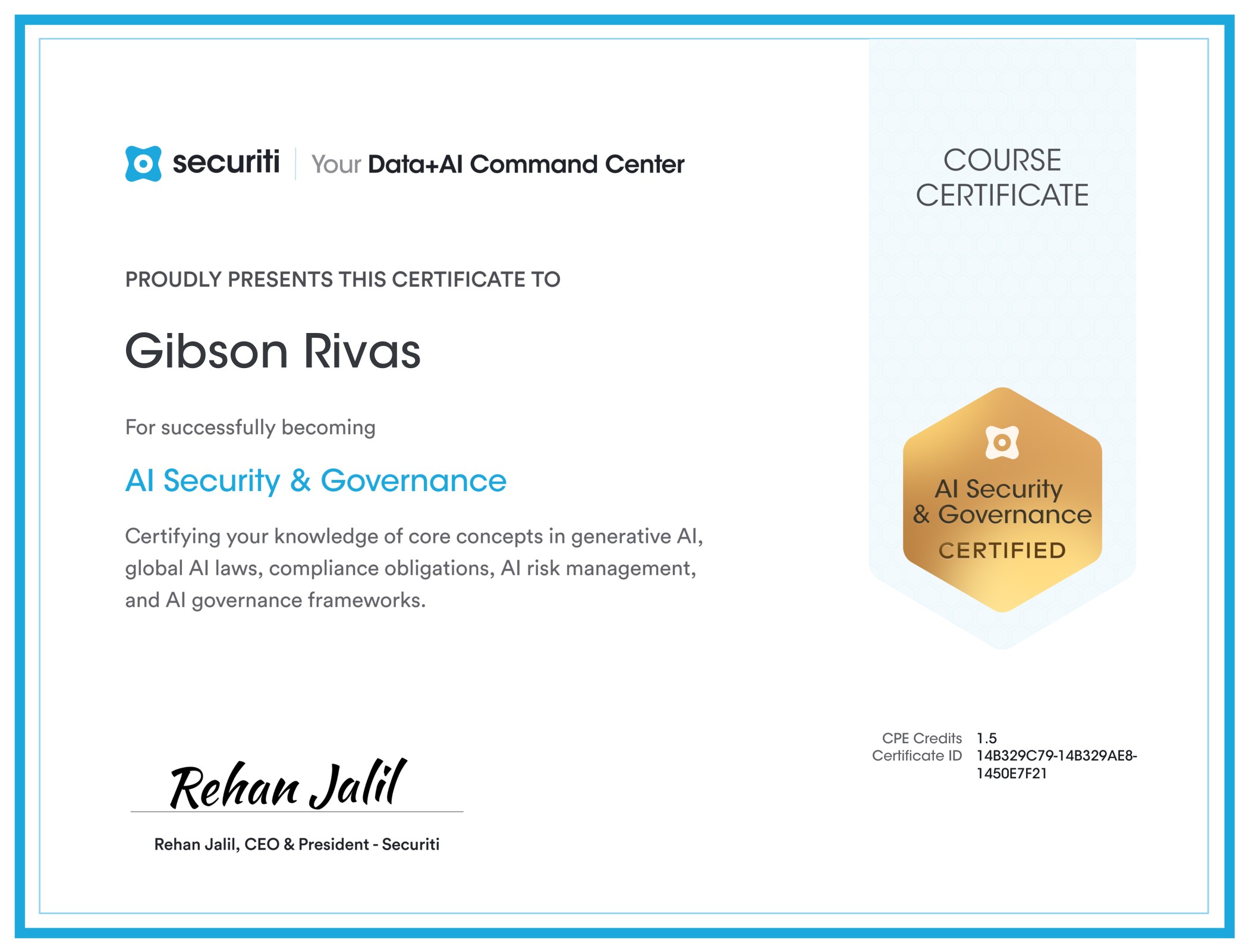
Securiti certificate: Gibson Rivas has successfully completed AI Security and Governance, certifying knowledge of generative AI, global AI laws, compliance obligations, AI risk management, and AI governance frameworks, signed Rehan Jalil, CEO and President, Securiti
AI Security and Governance Certification. Securiti, 2026.

Past projects.

Fourteen builds, in construction, healthcare, purchasing, research, and my own back office. The five below are shown in full: four next to the pipeline that actually runs them, and a room modeled from three phone photos. The rest are grouped underneath.

Construction and HVAC

Revit data normalizer into selection

n8n

Equipment schedules get flattened into PDFs and everyone downstream recounts them by hand. This takes the structured export, turns it into a clean equipment list, and runs it down two selection paths, every line tracing back to a source row. Tested end to end on a 712-piece schedule built as a test case.

Healthcare

Founding-executive search for a nonprofit clinic

Claude · Firecrawl · public filings

A nonprofit behavioral health startup needed a founding director it could afford, and public filings publish what every nonprofit executive actually earns. Scored 2,495 people from public records down to ten verified finalists whose current pay fits, each backed by the filing it came from.

University research

Machine learning model for dementia prediction

Python · pandas

A university research project predicting dementia from patient data. Most of the real work was the unglamorous half: cleaning the dataset until it could be trusted, then training and comparing logistic regression and random forest classifiers.

Marketing and brand

Logo and brand system

OpenAI gpt-image-2 · Claude

The mark at the top of this page: a script generates a batch, a reviewing pass culls and refines over rounds, and the winning mark was rebuilt by hand as clean vector geometry. Twelve out of twelve final generations spelled the wordmark correctly.

Testing and trust

Calibration rig

n8n · Claude · OpenAI

Before an AI step gets trusted, it runs against known-correct cases with two graders, one on the answer and one on the reasoning, because the dangerous failure is a right answer reached for a wrong reason. Rules that survive get hardened into ordinary code that no longer needs the model at all.

On my own

Personal assistant

n8n · OpenAI · Telegram

I text a bot in plain language and it manages my reminders. "Remind me to call Marcus Tuesday at 3" becomes a dated card on my dashboard, and I can ask what is on my list or say which ones are done.

Morning email triage

Claude · Gmail

Twice a day a routine reads my inbox and decides which emails actually need a reply from me, with a standing rule that urgency claimed by a marketer is not urgency. What's left lands on one morning page.

Job-posting lead scanner

n8n · Apify · Claude

Runs every morning at 7am: scans admin-role job postings within 30 miles, scores each business against four qualifying gates, and emails a digest. Last full run: 46 fetched, 42 scored and emailed in 134 seconds.

Lead finder and qualifier

Claude · Tavily · Perplexity · Firecrawl

Give it a city and it builds a list of businesses worth walking into, screening for whether the decision maker is reachable and whether there is a visible sign of the problem I solve. Last run returned 39 ranked targets.

Start here, no charge

Would your team like a one-hour presentation, or a one-on-one conversation, on leveraging AI tools in business?

No charge for the presentation.

I can meet your team at your office, explain the fundamentals of modern AI systems and how they are best leveraged in business, and discuss if and how they could apply to yours. Below are some of the things we can cover; we are not limited to them.

What we discuss

  1. 1

    The fundamentals of modern AI and agents, and the tools available today.

  2. 2

    How your business uses AI now, and how new solutions can help it save time, money, or produce better quality output.

What we cover

1

Terms and definitions.

The seven basic terms, each defined before it is used.

Model
The thing that writes. It has no memory of its own.
Agent
A model in a loop, with tools. Not a chatbot.
Tool
Something it can do: a file, a calendar, a spreadsheet, email.
Memory
What survives between runs. Three kinds.
Hallucination
Confident and wrong. A model cannot tell you when.
Deterministic
Same input, same output, every time. Plain code, no model.
Agent harness
The structure it runs inside. Rules, checks, memory, permissions.
2

How an agent is configured.

How to set up the model, the memory, and the agent harness for effective use.

How an agent is configured Your question and the chat so far go into working memory, the context window, which is all the model can see right now. The model reads it and checks whether it is done. If not, it goes round again; if so, it replies. The run empties when you stop. Underneath, tools and three kinds of memory that persist feed the working memory: semantic memory holds durable facts such as standards and clients, procedural memory holds playbooks and skills written down, and episodic memory holds every past chat and job, dated. Only the relevant slice comes into the window. no: go round again yes YOUR QUESTION and the chat so far WORKING MEMORY the context window: all it can see right now LLM the model done? REPLY the run empties whenyou stop. The threememories below persist. TOOLS files · calendar · spreadsheets · email SEMANTIC durable facts: standards, clients PROCEDURAL playbooks and skills, written down EPISODIC every past chat and job, dated only the relevant slice comes into the window
3

Where it fits in your business.

Every job queues behind one step. Aim the agent there.

Where it fits in your business Four steps in a line: calls come in, proposals go out, work gets done, cash comes in. They can handle 5, 3, 5 and 5, so the line puts out 3. Proposals are the constraint, where every job queues. Aim the agent at it; improving any other step just moves the queue. CAPACITYOUT 53553 callscome in proposalsgo out work getsdone cashcomes in The constraint: every job queues here. Aim the agent at it. Improving any other step just moves the queue.
4

How your people run it and build the next one.

Ideas come from whoever does the job. They build the second one.

Where solutions live Two overlapping ovals. Domain knowledge knows the problem but cannot build the fix. Automation knowledge can build but does not know what is worth building. Solutions live where the two overlap. DOMAIN KNOWLEDGE AUTOMATION KNOWLEDGE knows the problem. cannot build the fix. can build.does not know whatis worth building. wheresolutionslive

What teams want from AI implementation, and what they want to avoid

Method

Find it. Test it. Teach it.

Same three steps, same order, every time. One hour to find it, your own paperwork to test it, your people running it at the end.

Start with the free presentation. If it makes sense, a paid audit. Then the build.

How I work, in three steps Two lenses overlap: painful problems and the constraint. The overlap is the sweet spot. Pick one problem from it and test whether AI can do it better, faster, cheaper, proven on your real work. Yes leads to more time, more money, better output, run by your own people. No loops back underneath to pick the next candidate. STEP 1FIND THE CONSTRAINT STEP 2TEST IT AGAINST AI STEP 3IMPLEMENT AND EDUCATE Painful problems repetitive · boring time-consuming · error-prone → less pain The constraint the one bottleneck capping your output → more money the sweet spot pick one Can AI do it better · faster · cheaper? proven on your real work, not a demo yes no ✓More time ✓More money ✓Better output your people running it, not me Sometimes the answer is no. Then we pick the next candidate.
STEP 1

Find the constraint

We start with one hour and one job, walked end to end: the phone call, the quote, the work, the invoice. I mark every place it sits and waits, and it is often the same short list: the quote that takes three days because one person prices everything, the inbox nobody opens until Friday, the spreadsheet somebody retypes out of a PDF every Monday. Most of those are just painful. One of them is setting how much work you get out the door, and we name that one together, in plain terms, before anything gets built.

Most shops already know which one it is. They just have not said it out loud.

STEP 2

Test it against AI

Then we point the tools at your real work: your own quotes, your actual PDFs, the ugly ones with handwriting in the margin. Can they do it better, faster, cheaper, and reliably enough to trust? The bar is simple: if checking the output takes about as long as doing the work yourself, it failed. I would rather find that out before you pay for a build than after.

Sometimes the answer is no, and then we test the next candidate on the list. If none of them hold up, I say so and walk.

STEP 3

Implement and educate

I build it into the work you already do: your forms, your quotes, your files, your inbox, not a chatbot bolted on the side. Then I sit with the people who use it until they can run it, tell when it is wrong, and change it themselves.

If you never call me again, the thing still runs on Monday.

Why it works

The thinking comes from Goldratt's Theory of Constraints: every business has one bottleneck that sets its pace, and improvement anywhere else mostly evaporates. What makes AI different is what happens to the time it frees: automate the repetitive work and those hours can be reapplied directly at the constraint. That only works if your people are free to move to it, and when they are not, you get productivity slop: one team going faster and the business shipping exactly the same amount. Speed anywhere else is just motion; speed at the constraint is growth.

The guarantee

I'm not done when it's built. I'm done when your people can run it without me. If they can't, I'm still working. No extra charge.

Most AI projects don't fail because the technology doesn't work. They fail because it gets built, handed over, and never used. So I don't define "done" as delivered. I define it as your team running it without me.

This holds as long as you give me one person to work with: a couple of hours a week through the build and the training.

The paid step

Start with the audit.

You know your business. I know what these tools can actually do. The audit is where those two meet. I walk your operation end to end, name the one thing capping your output, and tell you straight whether new technology can touch it, including when the answer is no.

The one-hour presentation comes first, no charge. The audit is the first paid step, and nothing gets built before it.

You walk away with

  • Your constraint, named in plain terms, and whether AI can touch it
  • Two or three specific candidates to test
  • Live demos of real tools, not slides
  • One page to keep, whoever you hire

What I get

  • An understanding of how your business actually runs
  • Where your constraint is
  • Where new technology can be applied, and where it can't

The honest no is part of the deal. If your constraint is something AI can't touch, I'll say so plainly and we stop there. You'll still have a clear map of where your own work gets stuck, which is worth having either way.

Why me
I start with the constraint, not the software.
Every business has one bottleneck setting its pace. The first hour goes to finding yours, and nothing gets named as a tool before that.
Your people run it when I am done.
I build into the forms, quotes, and inbox you already use, and I stay until the people who use it can run it without me.
You get told when the answer is no.
If these tools cannot touch your constraint, you hear it on the first call and we stop there.
Fit

Who this is for.

Probably you, if

  • You run a small business, roughly 5 to 50 people
  • The work piles up on your best people and you can't hire your way out
  • You're in Central Iowa and prefer someone who shows up in person

Not for

  • Enterprises: you already have this person, and that's the point
  • Anyone shopping for a particular tool. The constraint gets named first, and the tool comes last, if one is needed at all
One hour, no charge

Let's find a time.

If you would like to set up a presentation, contact me by email or give me a call. Either one reaches me directly, usually the same day.

The presentation costs nothing. The audit and anything built after it are paid, and we can talk about that when we meet.

(515) 803-3920